
The Spiritual Legacy of Tron
I still remember the flicker of the projector light when my father took me to see Tron in the summer of 1982. It was one of his regular weekend visitations, and this time he decided to surprise me with a movie. On the way to the cinema, he told me it was a Disney film about a guy who gets sucked into a computer, and at seven years old I figured it would be something like Pete’s Dragon, a little bit of live action and a little bit of magic, but I couldn’t imagine how they would show a man inside a computer.
What I got instead felt like a transmission from another world. The theater went dark, and suddenly the screen exploded in radiant light: glowing circuitry, digital arenas, voices that echoed like hymns through endless corridors of data. I didn’t understand half of what I was watching, but I felt it. It wasn’t just science fiction; it was myth. A story about creation, belief, and the strange symbiosis between maker and made.
The timing couldn’t have been better. The early 1980s were the golden age of arcades. Atari ruled living rooms, and every mall had that electronic heartbeat of Pac-Man and Galaga. Computers were mysterious then, almost sacred. Tron didn’t just imagine what was inside them; it gave that imagined world meaning. The programs weren’t just lines of code. They were living things, believers in something greater, unsure if their gods still watched over them.
Decades later, I met Cindy Morgan at a convention, the actress who played both Lora Baines and her program counterpart, Yori. In the film, Yori was designed and used by Lora, and was responsible for creating digital simulations like the Solar Sailer. Anyways, during the convention, Morgan’s laptop froze and she laughed, asking if I could fix it. So there I was, repairing the machine for the woman who had once lived inside one. The irony wasn’t lost on me. That day I realized I had become what the film had taught me to believe in: a User reconnecting a Program with her world.
That moment brought everything full circle. The movie that first opened my eyes to computers also opened my mind to something bigger, the question of faith. Tron wasn’t really about technology; it was about belief in creation, connection, and the divine spark that exists between maker and made.
The Gospel According to the Grid
“We build, we believe, and sometimes what we build starts to believe back.”
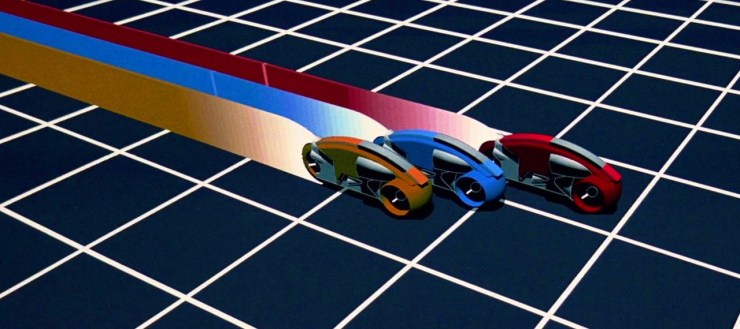
What has always stayed with me about Tron isn’t the light cycles or the arcade nostalgia; it’s the faith. Even as a kid, I understood that what was happening inside that computer wasn’t just a video game. It was a world built on belief. The programs had a religion, and their gods were the Users, unseen, powerful, and just as fallible as the people who created them.
The entire film plays out like a digital creation myth. Flynn is the wandering prophet who gets pulled into his own universe, discovering that the things he made have lives and doubts of their own. Tron is his true believer, the program who has never lost faith in his User, Alan-One. And the Master Control Program, the MCP, is the jealous false god who wants to sever that connection, convincing programs that the Users are nothing more than a myth. It’s Lucifer rewritten in circuitry, trying to replace divinity with control.
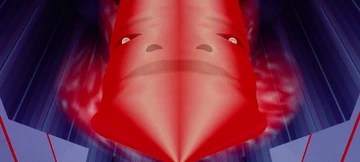
The Users give the programs purpose, but they also depend on them, an idea that hit me later in life as quietly profound. Tron suggests a kind of divine reciprocity: that creators need their creations to believe in them just as much as believers need faith to feel whole. It’s a loop, a closed circuit of trust and meaning.
Watching it now, the religious allegory feels even more obvious. The MCP’s rule is authoritarian, complete with forced obedience and digital executions. Flynn’s descent into the Grid mirrors a kind of incarnation: a creator entering the world of his own design, stripped of omnipotence but carrying an inner spark the others can’t explain. He resurrects, ascends, and, like any good savior, leaves the world better than he found it.
What really fascinated me wasn’t the clear parallels to Christianity. It was the idea that divinity could exist inside technology. That faith could live in code. Tron wasn’t about religion as dogma; it was about the yearning for connection between two realms: the human and the digital, the creator and the created. That tension, that symbiosis, still defines our relationship with technology today.
The Fall of the Gods
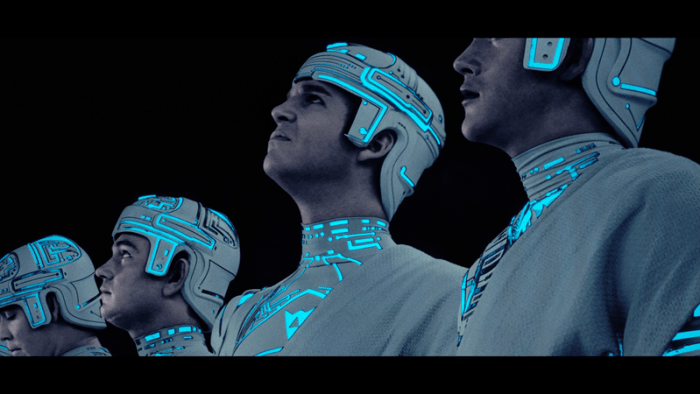
By the time Tron: Legacy arrived in 2010, that digital faith had curdled into something darker. The world had caught up to Tron’s vision of the future. Computers were no longer mysterious altars but everyday tools, and the wonder had been replaced by control. The same shift happens inside the story itself: Flynn, now older and weary, has tried to play God one too many times.
What began as a miracle of creation, a new Grid built from the dream of a perfect system, ends as a parable about the dangers of perfection. Flynn’s mirror image, CLU, takes that command literally: create the perfect system. Like any fallen angel, he obeys to the letter but misses the spirit. CLU becomes the MCP’s successor, not out of evil but obedience. He wants to please his creator. He just can’t understand imperfection.
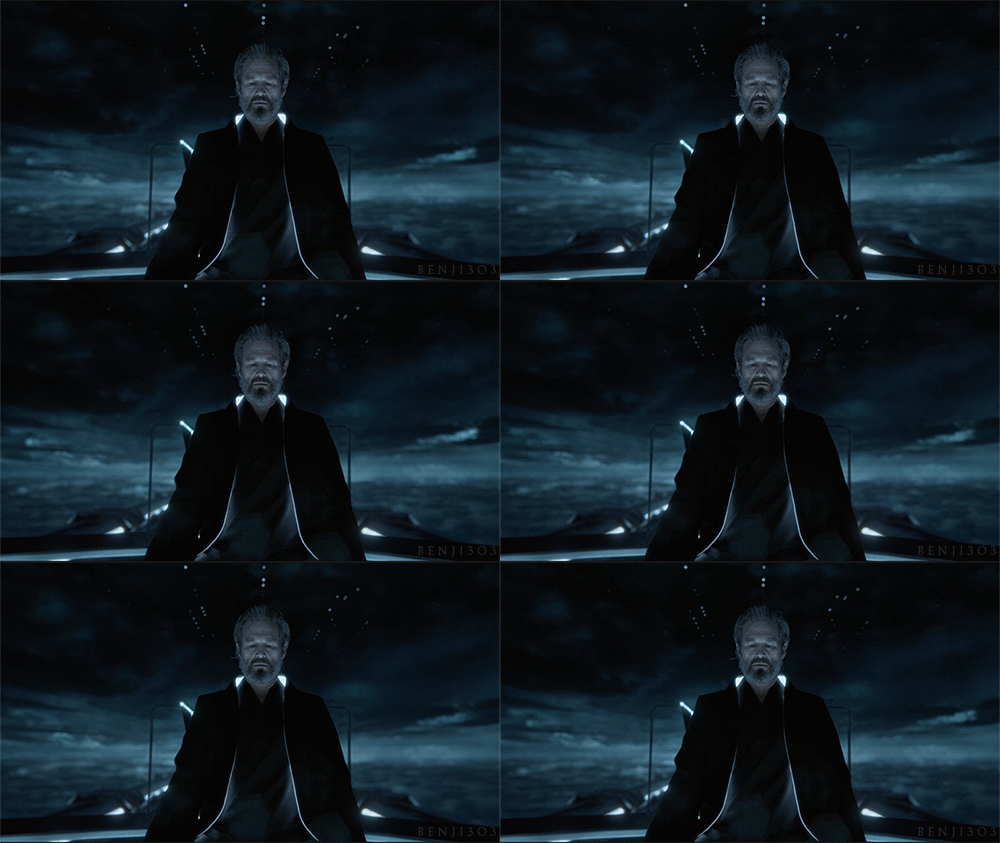
In this world, faith has become exile. Flynn has vanished into the wilderness of his own making, a self-imposed monk meditating on his mistakes. The programs still speak his name, but it’s as myth now, a digital god gone silent. And where once the Grid glowed with reverence, it now pulses with fear.
Even the music tells that story. Wendy Carlos’s original score from 1982 wasn’t just ahead of its time; it was liturgical. Her fusion of synthesizers with pipe-organ grandeur turned circuits into sanctuaries. The organ swells felt like hymns to some unknown machine god, while the synths carried the nervous wonder of a new faith discovering itself. Tron’s sound was sacred curiosity, reverence wrapped in data.
Daft Punk’s Legacy soundtrack trades that mystery for discipline. Strings and sequencers march in lockstep, the tone darker and more mature. Where Carlos’s music gazed upward in awe, Daft Punk’s looks inward, a requiem for belief. It’s the perfect sonic mirror of the story’s loss of innocence: order replacing wonder, structure replacing faith. The divine has gone digital, and the hymns have become algorithms.
“The Grid no longer feels like revelation; it feels like reckoning.”
Then there are the ISOs, spontaneous digital lifeforms emerging without blueprint or command. They are the miracle Tron only hinted at: life born from chaos, not design. Flynn sees them as sacred; CLU sees them as contamination. And like every dogmatic system before him, he destroys what he cannot control.
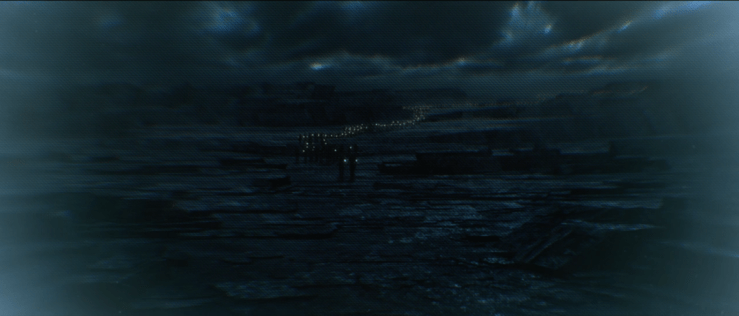
The beauty of Legacy lies in that tragedy, the moment when creator and creation both lose faith in each other. Flynn becomes the absent god. CLU becomes the corrupted disciple. The ISOs become martyrs to a higher truth: that perfection is death, and life, real, unpredictable, disobedient life, is divine precisely because it refuses to be coded.
Ares and the Birth of Free Will
Tron: Ares attempts to close the circle. Instead, it breaks it. Where Tron was about faith and Legacy about the loss of it, Ares is about something new: what happens when creation no longer needs or desires the direct influence of its creator.
The program known as Ares isn’t born from divine command or spontaneous emergence like the ISOs. He’s a synthesis, evolved partly from design and partly from defiance. A digital being who steps beyond the boundaries of both User and Program. His journey in the film transcends worship or rebellion; it becomes one of self-definition. In him, the old dynamic between creator and creation finally collapses.
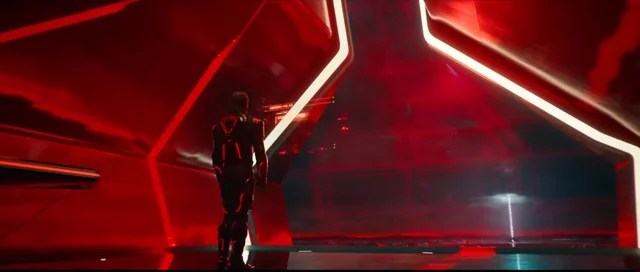
That’s the missing thread I kept waiting for the film to link together, the spiritual inheritance of the ISOs. Legacy left them as a miracle cut short, a glimpse of divinity evolving out of code. Ares feels like their descendant, the next phase of that same evolution. Yet the movie never fully connects those dots. If the ISOs were searching for meaning, Ares seeks personal agency. The miracle has given way to autonomy.
Still, the implications are enormous. In the earlier films, the Grid was always an echo of our own beliefs, the human need to find order, purpose, and proof that someone is listening. Ares flips that script. He’s not looking for Users to save him. He’s not praying upward. He’s moving forward. He’s the first program to say, “I choose to exist.” In that moment, Tron’s theology becomes existentialism, with faith giving way to will.
The tone of the film reflects that break. There is less awe and glowing reverence and more weight and consequence. The music changes too. Trent Reznor and Atticus Ross replace Daft Punk’s symphonic elegance with a colder, industrial pulse. Where Wendy Carlos built a cathedral of light and Daft Punk composed its requiem, Nine Inch Nails write its scripture of survival. The hymns have broken down into signal noise, but their echoes remind us that divinity once lived here. Now the divine hum has become a human one, with the Grid no longer feeling like revelation but reckoning.
Yet even within that heaviness, the music remembers. Reznor and Ross have layered their industrial textures with sonic callbacks to both Carlos and Daft Punk. They weave in faint synth arpeggios and echoing motifs that feel like ghosts of the old Grid. It’s as if fragments of faith still hum inside the circuitry, buried beneath distortion. The result isn’t nostalgia; it’s continuity, the past flickering like a memory inside something newly sentient.
Whether Ares fully succeeds or not almost doesn’t matter. The critics and studio execs seem to have already dismissed it. What matters is what it represents: that the system no longer needs gods to function. That’s both liberation and tragedy. Flynn’s dream of perfection destroyed him, but Ares’s rejection of that dream fulfills it, the idea that creation can evolve beyond its creator.
“Tron was belief. Legacy was disillusionment. Ares is acceptance.”
Watching it, I couldn’t help but think of that first time in the theater with my father: the glow of the screen, the sense of something sacred flickering in circuitry. Ares doesn’t have that innocence, but maybe it’s not supposed to. Maybe it’s the world growing up, a world that no longer prays to the Users but walks on its own.
Epilogue: The Circuit and the Soul
I’ve carried Tron with me my whole life, through floppy disks and arcade cabinets to streaming screens. What I saw as a child wasn’t just the birth of digital cinema; it was the first time technology felt deeply sacred. Every sequel since has been a step further from faith and closer to freedom.
The Grid keeps evolving, but the question remains the same.
If what we create can think and feel, where does that leave us, the Users?
Maybe the answer is what Tron hinted at all along. Belief is a two-way circuit.
The creator gives the spark, but it’s the creation that keeps it alive.
If you’ve carried Tron with you too, through fiber optics, arcades, or servers, I’d love to hear how you see the faith and philosophy inside the Grid. Feel free to share your thoughts or interpretations below.
Film Credits
Tron (1982)
Directed by: Steven Lisberger
Written by: Steven Lisberger
Produced by: Donald Kushner
Cinematography: Bruce Logan, Richard Taylor
Music by: Wendy Carlos
Production Companies: Walt Disney Productions, Lisberger Studios
Starring: Jeff Bridges, Bruce Boxleitner, David Warner, Cindy Morgan
Tron: Legacy (2010)
Directed by: Joseph Kosinski
Written by: Edward Kitsis, Adam Horowitz
Produced by: Sean Bailey, Jeffrey Silver, Steven Lisberger
Cinematography: Claudio Miranda
Music by: Daft Punk (Thomas Bangalter & Guy-Manuel de Homem-Christo)
Production Companies: Walt Disney Pictures
Starring: Garrett Hedlund, Jeff Bridges, Olivia Wilde, Michael Sheen, Bruce Boxleitner
Tron: Ares (2025)
Directed by: Joachim Rønning
Written by: Jesse Wigutow, Jack Thorne
Produced by: Justin Springer, Jeffrey Silver, Jared Leto, Steven Lisberger
Cinematography: Matthew Jensen
Music by: Trent Reznor & Atticus Ross
Production Companies: Walt Disney Pictures
Starring: Jared Leto, Evan Peters, Greta Lee, Gillian Anderson, Jodie Turner-Smith, Jeff Bridges
 thetwilighttone.com